Detect
Deadlines, integrity checks and supervised services make failures visible instead of silent.
Bounded · fail-closed · observable
REIST-OS is a compact 32-bit x86 research operating system built to detect faults, contain damage, recover state, validate the result and only then reintegrate a component.
[boot] kernel CRC32 verified
[storage] AHCI controller ready
BOOT_OK
RESOURCE_QUARANTINED 0
media identity verified
undo journal recovered
storage fence released
RESOURCE_REINTEGRATED_RW 0
C:\>_
Engineering principles
Every critical path is designed around explicit bounds, protected state and evidence-driven recovery.
Deadlines, integrity checks and supervised services make failures visible instead of silent.
Ring-3 domains, generation-scoped handles and output fences limit the authority of failed components.
Transactional storage and bounded restart paths restore a known state without blind retries.
Fresh reads, identity checks, CRCs and self-tests verify the result before capability is restored.
Read/write access returns only after every required recovery gate has passed.
Build IDs, failure context and bounded panic records turn hardware tests into actionable evidence.
System architecture
Verified project status
REIST boots through its own BIOS/MBR path, runs isolated userspace programs and has completed a real SATA disconnect/reconnect recovery without leaving the volume read-only.
Research scope: REIST-OS is not certified and does not claim general fail-operational or safety-critical suitability.
AI transparency
REIST-OS is developed with agentic AI assistance to automate as much implementation, testing, documentation and repetitive verification as responsibly possible. This use is disclosed so the origin and review path of project changes remain clear.
AI does not develop REIST-OS without control.
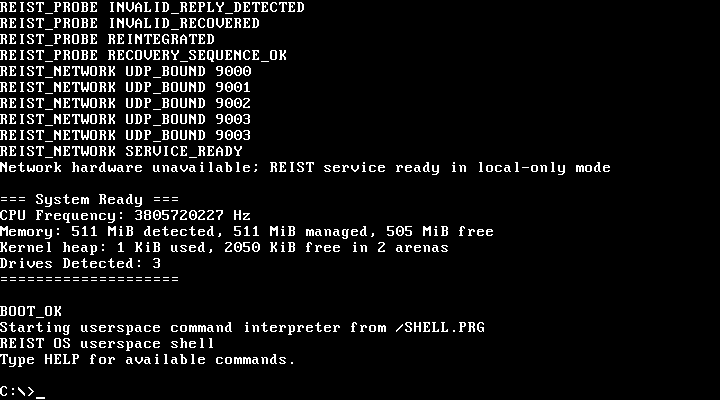
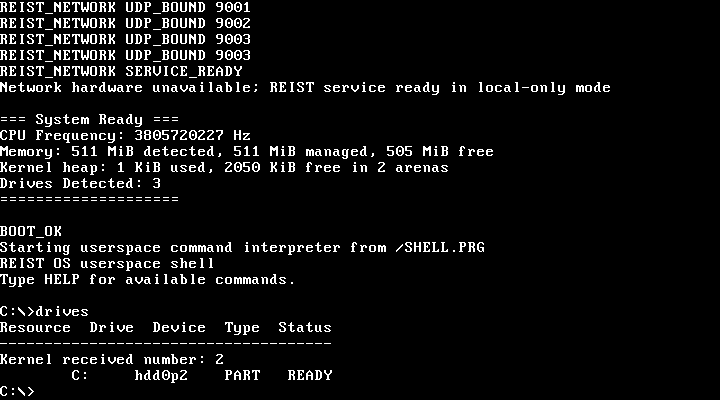
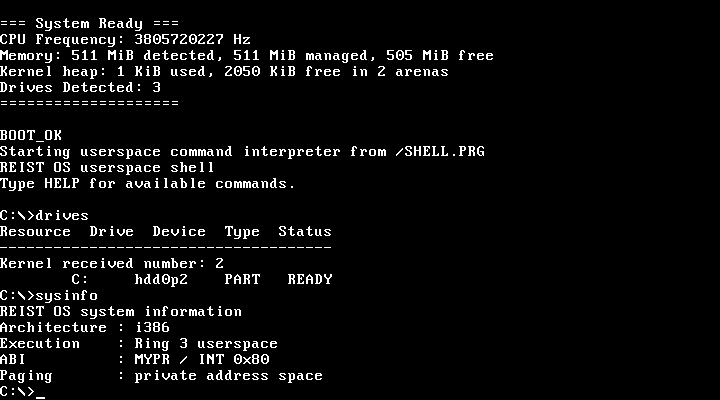
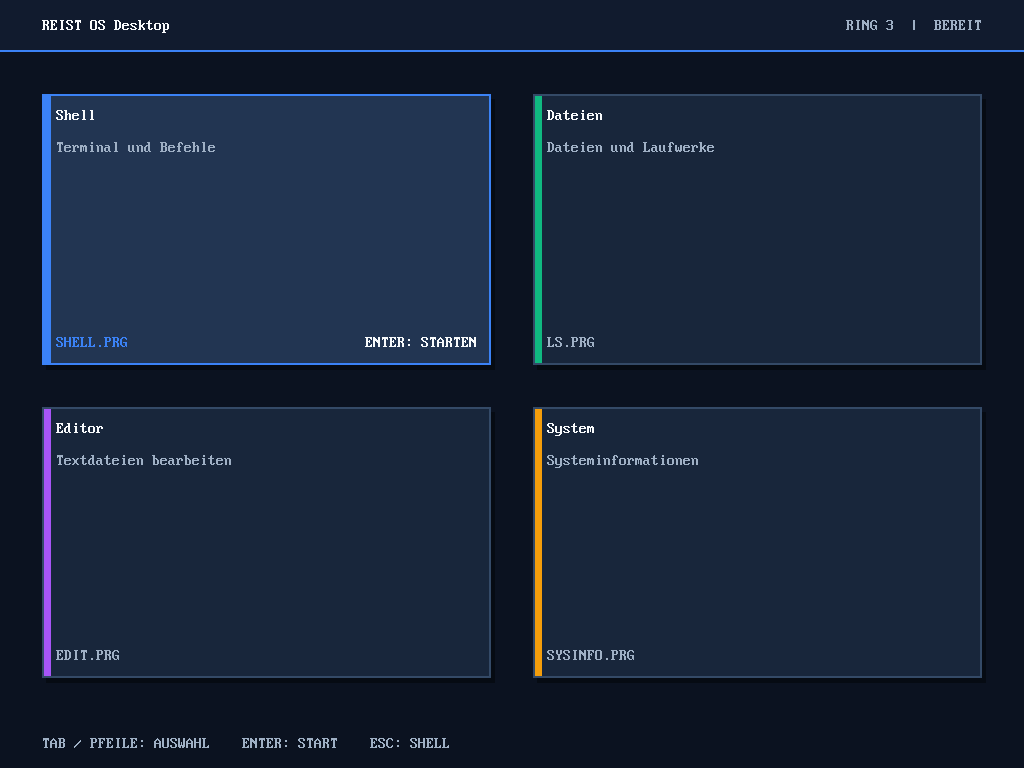
Captured from QEMU
These views are generated automatically from current REIST-OS images and can be refreshed with the repository capture script.
Build and run
The Windows build produces a raw BIOS disk, a floppy image and a ready-to-run VMware package.
.\scripts\build-windows.ps1 -Target real_hwOutput: build\reist-os.img
REIST-OS
The source, tests, architecture contracts and executable roadmap are available together.